 When the Delaware Valley Industrial Resource Council was charged with
connecting the science, technology, engineering and math (STEM) projects
and resources throughout its region, it knew it wouldn’t be easy.
With hundreds of researchers and thousands of ideas, research papers and
manufacturing concepts to sift through, the Northeast Philadelphia
economic development agency started out lost in a veritable wilderness
of disparate information, trying to find its way home. What they needed
was a map.
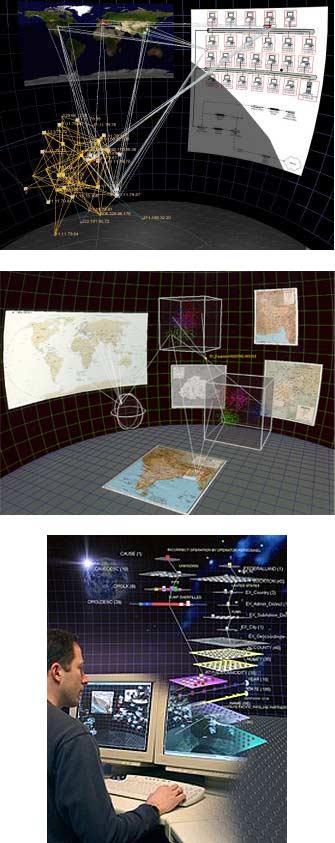
This week, through a $300,000 National Science Foundation grant, DVIRC announced an agreement with researchers at Ohio State University to utilize Starlight, an advanced information mapping
tool capable of leading the way out of the disparate data wilderness.
Developed through a partnership between OSU and the Pacific Northwest National Laboratory, Starlight takes millions of informational inputs
and displays them as timelines, dot graphs, hierarchy charts, spatial
maps and other useful visualizations.
“I don’t know that this
would be analogous to social networks because social networks are about
sharing and collaborating,” says DVIRC spokesman Tony DeFazio. “Think of
it as a digital map identifying projects that are underway, who is
doing what and their linkages. How are they connected to other projects
in the region. And at the end of the day, it will provide a clearer
picture of the strengths and weaknesses within our region to build
advanced manufacturing and spur innovation.”
As pioneers in STEM
development, DVIRC created the STEM Compact with the NSF-funded Math and
Science Partnership of Greater Philadelphia in 2006. The document,
which was the first of its kind outlining STEM as an educational sector
capable of creating industry and development, presented ways
regions could mine their STEM sectors to create jobs and launch new
businesses. The National Science Foundation selected the Greater
Philadelphia region as a way to test the Starlight system’s application
to a regional STEM effort. Teams from DVIRC, Ben Franklin Technology Partners and the 21st Century Partners for STEM Education will head to
Columbus this week to begin training and mapping the way to the Delaware
Valley’s STEM future.
This work builds upon our Regional Compact for STEM Education and will set the stage for a more robust series of partnerships and relationships to support a full range of STEM-related activities,” says former NSF CEO Joseph Bordogna. “By linking sets of data visually, stakeholders will able to more intuitively understand, see, and cultivate key linkages and relationships.
Source: Tony DeFazio, DVIRC
Writer: John Steele