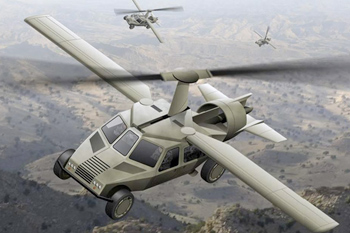
 Carnegie Mellon University’s Robotics Institute, makers of the world’s first auto-piloted robots, has landed a $988,000 contract from DARPA to build an autonomous ground vehicle that can morph into an aircraft during military missions.
Need a mental image? Picture a Humvee on the ground that transforms into a helicopter while taking off into the wild blue yonder minus a pilot. The craft would be flown by a soldier with no pilot training and would transport up to four people and 1000 pounds of payload up to 250 nautical miles, says Sanjiv Singh, CMU research professor of robotics.
The plans calls for using it on scouting, resupply and medical evacuation military missions.
Carnegie Mellon is one of six companies to receive a piece of the project, a $4.75 million total award that is part of DARPA’s Transformer (TX) Program. Carnegie Mellon’s task is to develop situational awareness, collision avoidance and intuitive control for the overall design.
“The TX is all about flexibility of movement and key to that concept is the idea that the vehicle could be operated by a soldier without pilot training,” says Singh. “In practical terms, that means the vehicle will need to be able to fly itself, or to fly with only minimal input from the operator.”
Carnegie Mellon has had a long history in autonomous driving, beginning with robots such as DEPTHX, a NASA submarine that has explored the world’s deepest sinkhole. Carnegie Mellon also won the DARPA Urban Challenge, an urban road race across the Mohave Desert in which a driverless SUV named Boss cross the finish line first. The university also worked with Piasecki Aircraft Corp. on an autonomous helicopter that flies at low altitudes while avoiding obstacles, a difficult feat.
Other contributors to the project include: Honeywell Laboratories, which will work on the human issues of the program; AAI Corp. and Lockheed Martin Co., who received the biggest chunk of change, about $3 million and will contribute to the overall design concepts and transformational elements; and Pratt & Whitney Rocketdyne, which is working on the engine technology.
Source: Sanjiv Singh, Carnegie Mellon University
Writer: Deb Smit
For more of Pittsburgh’s latest and greatest, sign up here to receive Pop City for free in your inbox each week.